Tag Archives: writing

My books. Definitely not the 6 minute read

25 Sep

I have a lot of interests. They keep me busy. Sometimes I don’t know what to get to next. I have so many projects on the hop … and I work too being a teacher, and that takes time and preparation.

Right now, I am working on a novel and a script. Both are unfinished. I leave them for a while and then return. But these works are always working in the depths of my mind. 

Sometimes I make notes. Physical ones in little notebooks. I have lots of these notebooks and diaries spanning my entire adult life. I have kept them all. Occasionally I dip into them and see what I was doing and how I was feeling and dealing with life’s challenges. Sometimes I wonder why I keep them, these old dog eared volumes. Who will read them later on? Will they be thrown into rubbish bags or will they mean something to someone in the future?

They mean something to me.

It’s like my books.

I’m not sure if it’s fashionable to collect and read books anymore in the era of the 6 minute read. I have my collections. Graham Green, who famously wrote The Third Man and Brighton Rock and who worked for the British secret service. Check out Slow Horses on Apple TV to understand the fascination with cloak and dagger characters.

The American author and pioneer of short prose Raymond Carver whose stories convey a darkness and depth in sometime everyday occurrences. Like his story, ‘A Small Good Thing’ of the lady that went to a baker to order a birthday cake for her young son. The baker was a cranky man. Matter of fact and short tempered with his customers. He was angry when the lady didn’t return to pick up the cake. I’ll let you read the story. It’s longer than a 6 minute read.

I have a battered and treasured copy of Ukrainian writer, Anton Tchehov‘s short stories. Even though he wrote almost 100 years ago, he is acknowledged as a master of the modern short story his themes are modern and his style flows. They can be deceptively simple in their themes – a lot is left to the reader’s imagination. His plays like The Cherry Orchard about family, debt and social change are classics still being produced.

GREAT AUSTRALIANS

The Australian journalist and poet Kenneth Slessor also means a lot to me, not only because he wrote Five Bells, about his mate Joe who went missing on a ferry in Sydney harbour and drowned one night, but also because he was a friend and colleague of my father Bill Rodie, who was also a journalist in Sydney back then.

NEW GENERATIONS

I have always been fascinated by social movements and Jack Kerouac and his fellow beats had a big impact on America and the world back in the fifties and sixties. They illuminated a different style of living that didn’t fit with the glossy consumer focused perfect families of the fifties with their gleaming cars and happy stay at home moms cooking for the family in perfect, gleaming kitchens full of gleaming appliances.

The beats gave birth to the hippies who also ushered in new sensibilities. The hippies gave birth to the punks who gave birth to the … well you get my drift.

The beats included iconoclasts like the poet, Allen Ginsburg and William Burroughs whose writings influenced by be bop jazz took readers to places they’d never been filled with drugs and dealers and humour. Burroughs was droll. Check out his readings on Youtube.

FROM NEW YORK TO PARIS TO BIG SUR

One of my literary heroes is Henry Miller who left New York in the 1930’s to live and write in Paris. Back in those days Paris was a mecca for artists. It was cheap and liberated full of like minded ‘bohemians’ all trying to create something. Henry was so poor when he arrived there that he asked all of his friends to send him a dollar a week. A novel idea that worked while he worked on his novels. Today you’d need a thousand friends. He famously broke taboos with his work. His books were universally banned like the famous Tropic of Cancer. I love his writing and fascinated with his story. later in life he returned to the states and settled in Big Sur. Back then it was back roads and wild. An unspoiled landscape of sea and slopes and wildlife. He thrived there and he influenced the Beats.

Books are important. Writers are too. And in the age of AI, these creators stand out.

“Books, my beloved companions, keep me tethered to the vibrant tapestry of life, love, and the eternal human drama.”

That was written by AI in the style of Henry Miller.

I think he could do better.

Somerset Maugham, the tiger and Raffles Hotel

7 Sep

maugham

Creativity seems to be a buzz word these days as is happiness. For us white bread types both can seem like butterflies in a strong breeze – now you see them and now you don’t. Try to capture them and they’re gone.

Now take W Somerset Maugham for instance. He was creative undoubtedly. Still considered one of the great short story writers ever. If you haven’t done so, read some of his ‘south seas’ stories like ‘Rain’ for instance featuring the morally questionable Sadie Thomson and monsoons that drove people crazy. Often set in exotic places like Pago Pago and Apia when the copra trade and rubber plantations were booming – the islands full of boozy ex pats and over zealous missionaries with sin on their minds.

I was lucky enough to stay at Raffles Hotel in Singapore before they modernised it. There was a suite there named after Maugham and one called the Conrad suite. They both stayed there regularly. There was a snooker table in a colonial space where it was rumoured that the last tiger in Singapore was shot. “Jolly good show. Got him right between the eyes!” Definitely not correct these days.

So Maugham, Raffles, tigers … and creativity of course.

You can set up a room with toys and games tables for creative thought. Or you can’t. How do you capture creativity? 

More importantly … how do you monetize it?

Publishing is a business like the movies or games. You don’t get published if you don’t have a market.

There has always been creativity in business. They just didn’t use the term so much.


Raymond Chandler, his hat, and the mechanics of writing

11 May

Image

I admire Raymond Chandler and I love his hat. It’s straw unlike his writing.

For those of you who aren’t familiar with him, Chandler was probably the godfather of the hard boiled private eye. That may sound like a Bedouin dish but it’s a description of a certain literary genre.  The pulp school of crime fiction. Chandler was an interesting character himself. Raised partly in the barren mid west of Nebraska and partly in an English public school, his metaphysical trajectory included stints as an accountant for an oil company and an alcoholic. The alcohol produced blackouts, he forgot to go to work and he lost his comfortable job which left him holding his hat. It was the tail end of the depression and Chandler lived at that time in Los Angeles. It was a lawless, corrupt place with bruising you couldn’t see.

Chandler had been dabbling in poetry since he was a schoolboy. He now had an opportunity. He decided to become a writer.

At that time, there was a magazine called The Black Mask. A pulp offering launched in 1850 by journalist H. L. Mencken and drama critic George Jean Nathan as a money maker to prop up a more literary offering, The Smart Set, “a magazine of cleverness”, was an American magazine of literature and culture.

Chandler was an intelligent man who approached his pulp writing with a scientific mien. Like Ernest Hemingway he laboured over unfussing his writing. It was all about the mechanics.

Chandler’s most famous invention was Philip Marlowe, the world weary gumshoe … sorry I had to say that. His novella’s – The Big Sleep and Farewell My Lovely are classics of the genre.

He wrote sentences like this

‘It was a good crowd for a Tuesday but nobody was dancing.”

Here’s to Raymond Chandler.

Do you think there’s some merit in cutting out the flap doodle.

On the internet no one reads anymore.

Remember Raymond when your writing.

Everybody loves Raymond.


Video

Interview with Tom Wolfe

9 Jan

This is an interview that Time magazine conducted with famed writer and novelist Tom Wolfe. The original chronicler of the ‘New Journalism,’ pioneered by Truman Capote (In Cold Blood) and others.

Tom Wolfe doesn’t use a computer. He writes by hand.

Masters of strategy Part 1

4 Jan

Image

Happy 2014 … a year of strategic thinking?

I’ve been lucky enough to spend time with a master of creative strategy, David Barnes who’s background in advertising is the stuff of legends.

David can draw and design and write and produce and … well you get my drift.

But via his business, Currency Ideas, he’s a thinker first and foremost.

His brand process takes clients on a journey of self discovery, because often we really don’t think about who we are and what we do best and better than anyone else.

Which is the whole point of living (and working) I guess.

To do things well.

David looks for reasons before developing logos/identities/websites/ads …

Reasons being objectives

A brand is a valuable asset after all.

being creative is strategic.


Meet Dr NO

12 Dec

Image

When my son was a toddler my dear mother in law happened to mention that it was sad that little kids heard the word NO a lot of the time.

NO you can’t do that.

NO don’t be naughty.

NO. NO. NO.

Workplaces can be like that too.

Have you worked with a Dr NO? I know I have.

NO, too different.

NO, you can’t do that.

NO, NO, NO.

What makes a Dr NO?

Fear of change

Insecurity

Resentment

Risk aversion

All of the above. The only problem is that the world is changing. Industries are disappearing. Just this week our iconic car, the Holden, announced they were ceasing manufacturing here. Horror. All those people losing their jobs.

What will they do?

They’ll do something else.

Creativity is the enemy of Dr NO

Change is like Ju Jitsu … when you are attacked you step aside and push your attacker past. Going with the flow.

Scary but ultimately satisfying.

Content design … Don’t put legs on snakes

26 Sep

ImageI learn some amazing things and meet some wise people as I go along. One such person is Albert. A graphic designer I sometimes work with. Originally from Hong Kong. he’s Chinese Australian or the other way around, depending on your point of view. Albert’s been honing his craft for many years, classically training as a graphic designer way before Adobe or Quark were on hand. In other words he’s an old hand.

One day I was sitting next to him, art directing a piece of marketing collateral. Pictures, text, logo etc. He was laying the page out and it looked good. Me being an advertising > marketing > sales kind of guy suggested he make the offer bigger. It didn’t have the prominence that I thought it should. Maybe I was after the butcher shop window look. This weeks special … portuguese sausages.

With glee in his eyes, Albert said ‘That’s right. We put legs on snake!’

An old Chinese proverb, it took me a second to understand what he meant.

Snakes are perfect. Sometimes they are superior.

Why put legs on them.

Designing content, bear this piece of wisdom in mind.

Don’t put legs on snakes.

Leonardo da Vinci and content planning

24 Sep

Image

I have developed content for a number of businesses as well as creating and delivering training programs (aka Instructional Design.)

Content can be for non-static websites; marketing programs or social media.

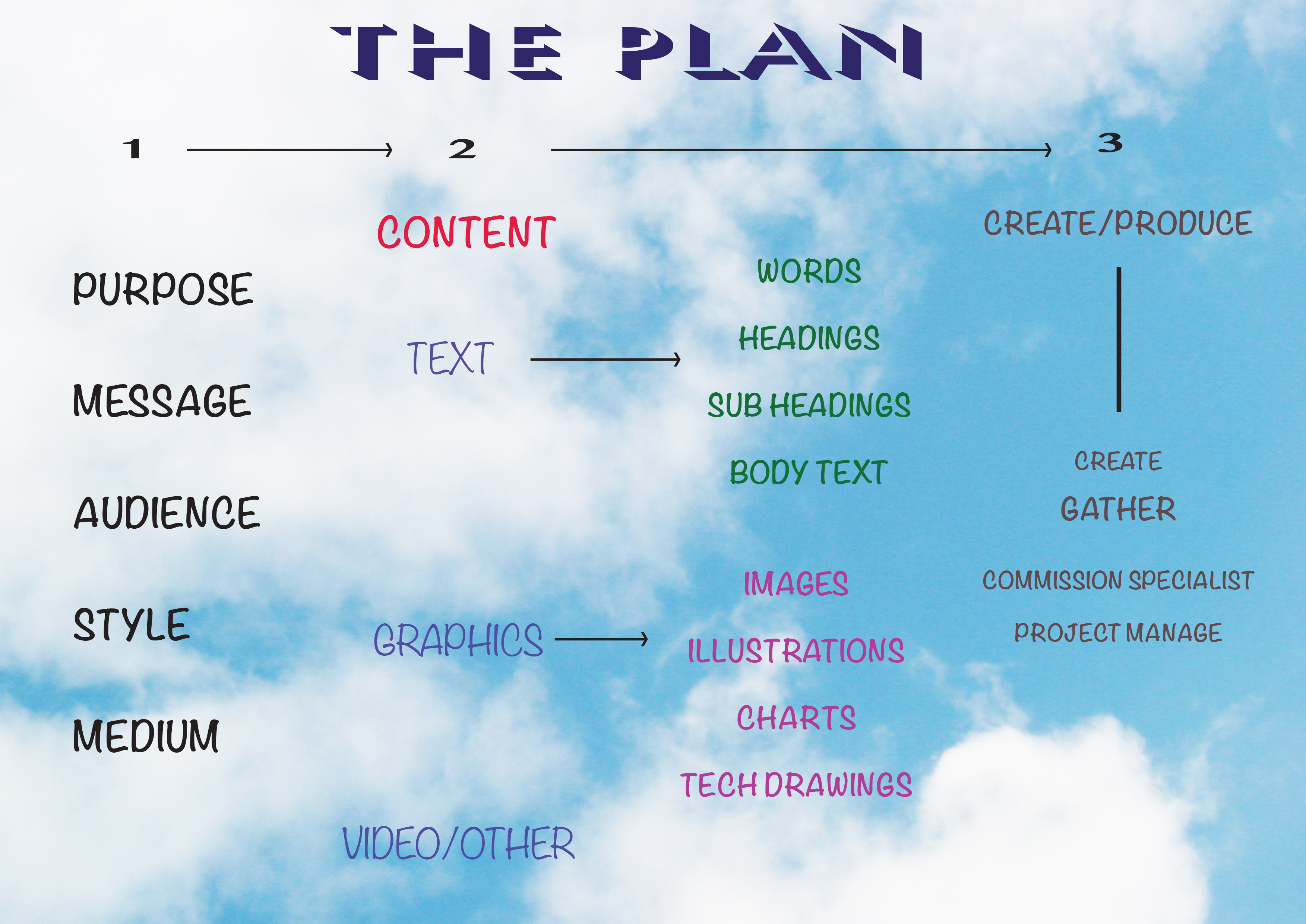
One thing became clear to me in the process. That is the importance of planning.

Having a series of plans that start with the Big Picture (see above,) is a good way to not only focus on what you are building, but also becoming ready to create and stay on track with projects.

Creativity is pure. We know that. Artists are born that way or are they? Real art is intuitive, it’s just there in moments of genius or is it?

Leonardo da Vinci and Michelangelo (both successful businessmen) produced ‘rough’ studies before creating their masterpieces.

My friend, famed Australian artist Rodney Pople, executes a number of sketches and daubs before he knows he’s on the track.

Writers plan and signpost using a variety of methods. Chapter headings is one way to write a novel.

Having a ‘helicopter view’ of what you are trying to achieve and then implementing it is a good way to plan and build.

It can be visual or text based. I find that visual is better.

Just get it all down and make your map.

I love it. Take it out! Part 1

21 Sep

ImageI got my first job in advertising by showing up at an agency with a two page short story I had written about bikies. I still remember one memorable phrase I concocted. It went something like ‘their jeans were so dirty, they could only be removed with a blow torch.’

The amazing thing was not only did I get in and meet with the Creative Director, but he gave me a job on the very lowest branch of the agency tree: the despatch department, run by a fiery red-faced ex army guy they called Sarge. I wanted to write. To create. I was on cloud 9 or maybe even 10.

For the first few days, the CD would acknowledge me. Smile. Ask how I was doing. That stopped soon after. But it was a great place to work. Big clients, global agency. A bunch of creatives around, artists, writers, producers, editors, designers. I loved it.

Then they promoted me to media accounts. Yike! That wasn’t my bag, so they put me into media planning, under a benevolent media genius who will remain nameless, but let’s call him Daniel Boyce. One day he called me into his office and asked me ‘so how are you liking it here?’ I was momentarily blinded by his striped shirt and the harbour view behind him, and blurted out without thinking ‘I don’t like it.’ Daniel fixed me with a steely glare, just as the phone rang. ‘Daniel Boyce.’ He said into the mouthpiece in a cultured accent, glancing at me with what I perceived as contempt. “I’m going to get fired.’ I thought, but no. Daniel put down the phone and asked me why I wasn’t happy in media planning. I told him that I wanted to write. To be a copywriter. To be a creative. The phone rang again. Same rigmarole. Then, ‘Thanks for being honest. Everybody lies to me around here.’

The next day I was relocated to the TV/Broadcast unit where ads were recorded and edited, pilots were made and new business pitches run.

We had two theatres and a big meeting room. I was able to watch actors, writers, engineers create, edit and senior executives pitch for new business. Something different everyday.

It may have been airlines and soft drinks but it was wondrous to me …

Newsletters that tell stories

3 Sep

310112 AAS A4 NL (Page 1)

Newsletters like this one from advanced anaesthesia specialists are a great way to differentiate, take ‘thought’ leadership within a category, build your brand, promote your business and sell, which after all, is the ultimate goal for any business … to make a profit!

Here’s the thing … newsletters must have some news not just a bunch of products. Newsletters tell stories.

Great … let’s do it.

Here’s the other thing … who cares?

Question: Do you understand who your customers are? Do you know what they think, hope for and need?

The rise of Social Media illustrates the fact that everyone wants to be loved, admired, supported and recognised.

Effective business communications 1st take customers seriously. They add content that tells stories customers want to read and that’s not always about product x or service y.

Newsletters like all marketing communications must have been through the so what test. Try some in house research. Involve your team. Ask your customers!

Create newsletters that hit the spot!