What gets you up in the morning?

27 Oct

Image

A good friend of mine and my former boss applied for a position with a company the other day. He was contacted by phone and one of the questions he was asked in a semi formal telephone interview was ‘What gets you up in the morning?’

I thought about that. Why he was asked that question when he was obviously a highly qualified and experienced candidate with a huge background and lots of runs on the board?

How do you answer that?

What’s the question driving at?

Some answers might be:

“I love my work. I’m lucky!”

“My kids school fees.”

“Life gets me up.”

“The smell of the coffee brewing.”

“The alarm clock.”

Sometimes it seems that HR people want to hear responses so that they won’t hire great people.

I know there must be some deep psychology behind that question, I just don’t know what it is, and I’m not criticising the HR person here. I’m sure they know why?

I get up for all the aforementioned reasons.

And I’m lucky … I do love my work. I don’t care what anyone else thinks.

Doing the absolute best that I can is just something that was hardwired in me by parents and circumstances.

But the barriers are put up. The hurdles to jump over.

People don’t score well in interviews for many reasons. Possibly the same reasons why different kids get bullied at school. They are different, unique, smart, sometimes odd, and … they don’t run with any pack.

As we all know, a lot of those kids went on to start up global phenomenons in the fields of art, business, music.

Let’s try and let the sometimes awkward ones in and lead them well. Stop putting up the hurdles.

Give them the confidence to do what they do best.

Do better things differently.

Revolutionise.

I believe it’s called constant improvement.

I just noticed that the clock is set to wake me at 8.02 PM. Better change that.

The art of the knowledgebase

26 Oct

ImageWebsites have evolved.

In the not too distant past, a business or organisation would have a ‘webmaster’ build a site. It had all the usual suspects: Home; About US; Contact Details; Products etc. You’ve seen hundreds of them. Maybe even thousands. Static sites with a flash animation graphic to spice things up. Looked good. Never or hardly ever updated except for new product offerings.

Nowadays, in the fast paced, quick clicking social media environment, more is required.

The big question is: why will customers visit your site? Better still, why will people who are not yet customers visit. We call them prospects from ‘gold prospectors.’ Digging for gold.

The gold you put on your site is what differentiates your business from your competition. Yes you’ve got great products. But sites need to offer value in a whole lot of other ways.

One way is to provide a knowledgebase.

Articles. White papers. Videos. Blogs. Put it out there.

But ask yourself the question. “Does this content do something for my clients, customers and all the prospects out there just waiting to find a solution to their problems?”

Well does it?

Cecil B DeMille and Learning Management Systems

9 Oct

moodleWhose heard of Cecil B DeMille? The great director of the silent film era. His epics such as the Ten Commandments and Cleopatra still rank as amazing spectacles. But many great silent directors fell foul to new technology. Back then it was sound. Now it’s the internet.

Online learning has taken off. Educational institutions and corporations have embraced learning management systems for a number of reasons. It’s always there, therefore learners can ‘learn’ in their own time. It’s cost effective, especially where training is linear such as workplace health and safety, it’s environmentally friendlier > less printing, and if utilised properly it can build a community of learners.

The problem with some LMS’ are that they are so often one dimensional. There are pdf’s to download and instructions. Learner’s log on and log off and log is a good choice of words here. ‘I slept like a log.’

When I deliver training, I am conscious of the people in the room. Are they engaged and interested? Are they enjoying themselves? Are they learning?

LMS’ should also engage learners and if they don’t, they aren’t doing their job.

The interface is the first place they arrive at. It should be planned and built to engage and motivate.

John Caples’ AIDA is about good advertising…

Attention … get their attention

Interest … and their interest

Desire … stimulate their desire

Action … forge action

It’s not about downloading online documents. Self directed learners want more of an experience.

Like a good website, static elements are not enough anymore. Consider multi=media, chatrooms, links and moderate. Keep the conversation going.

Don’t be afraid of new technology, but direct it like CB.

Whoever said ‘build it and they will come?’

5 Oct

Image

We all know how the internet has changed everything.

Now we learn, socialise, get medical treatment and buy online. It’s a revolution big or bigger than the one that brought industrialisation. Some say the industrial revolution also fostered a kind of anti socialisation. Small, close knit communities with thriving cottage industries were broken down as people moved to cities to find work in the factories and mills. Apologies here to Weber one of the fathers of sociology for this one minute noodle version of his and other’s theories.

I work in marketing and I have a background in retail. My grandfather had many thriving shops around Sydney and country New South Wales. In 1933, my Aunt, one of his 5 daughters started a fashion business called Coral Lea which lasted in one incarnation or another for almost 70 years. It was a famous ‘brand,’ and glamorous to the hilt. My mother had her turn, telling me that she left school at 15 and was in the ‘shop’ the next day. Not formally educated, she was just about the best business person I have ever worked with. I often quote her to my students and in my writings. When I left advertising (did I ever?) I went to work for her. She trained me by hand and without a volume of Kotler in sight. One day she asked me to ring Vogue. Vogue Magazine was the fashion bible back before fragmented virtual communities. I was, let’s say, more than hesitant. A young guy in a little shop with interesting things. All she said to me was ‘They’ve got an empty magazine to fill.’ I rang and they came and we were featured in an upcoming edition. It was a powerful lesson in PR and marketing as well as human behaviour. I was never afraid again to call important people or publications. We were unique and I knew it.

Now some say that retail is dead. That people are buying online and avoiding the shopping experience altogether. Why shouldn’t they? It’s easy to Google and compare. There’s billions of shops online.

So let’s do it. Find the shopping cart provider/software and follow the prompts.

Build it and they will come

Umm, I don’t think so.

We still have to tell people we have the shop, and to do that we need to find them. Where are they hiding today? Facebook? In your database? On linked In or Instagram?

Here are some questions:

1/ Do our products suit the online buying experience or are they too specialised?

2/ Do our customers need help to choose?

3/ Are they ‘freightable?’

4/ How do we lead our customers or prospects to our e-doors

We still need to use a mix of traditional and new media to promote our store and it will take some time.

Like this blog.

Frank Sinatra and content development. I did it my way

29 Sep

APPROVEDI love Frank Sinatra. His phrasing was amazing (sorry about that one!)

One of my favourites is his rendition of ‘My Way.’ Originally a french song and re-written by legend Paul Anka, it’s a testament to uniqueness, bravery. resilience and self belief. Ol’ Blue Eyes put in all the blows, hits and lingering disappointments. This song is about living and by the soaring end, this listener is in no doubt that Frank lived a life.

I’m a my way kind of person. Strong minded and creative. I often run on instinct fuelled by experience > what’s going to work and what’s not.

But here’s the thing: when you’re planning websites; developing content (products, knowledgebases, social platforms etc.,) always communicate with your stakeholders (internal and external) regularly, get approval and formal sign off. 

This is not always easy. You have to pitch it right and differently depending on your audience. The cost/benefit analysis.

Many great ad campaigns have been ruined by ‘the client.’ They just want the logo bigger. They often don’t share your enthusiasm for standing out in a crowded marketplace. But they are the client nevertheless, nervous or not.

Set up a ‘milestone’ approval system so that everyone’s on the same page. I do love cliches.

And stay brave!!

Content design … Don’t put legs on snakes

26 Sep

ImageI learn some amazing things and meet some wise people as I go along. One such person is Albert. A graphic designer I sometimes work with. Originally from Hong Kong. he’s Chinese Australian or the other way around, depending on your point of view. Albert’s been honing his craft for many years, classically training as a graphic designer way before Adobe or Quark were on hand. In other words he’s an old hand.

One day I was sitting next to him, art directing a piece of marketing collateral. Pictures, text, logo etc. He was laying the page out and it looked good. Me being an advertising > marketing > sales kind of guy suggested he make the offer bigger. It didn’t have the prominence that I thought it should. Maybe I was after the butcher shop window look. This weeks special … portuguese sausages.

With glee in his eyes, Albert said ‘That’s right. We put legs on snake!’

An old Chinese proverb, it took me a second to understand what he meant.

Snakes are perfect. Sometimes they are superior.

Why put legs on them.

Designing content, bear this piece of wisdom in mind.

Don’t put legs on snakes.

Leonardo da Vinci and content planning

24 Sep

Image

I have developed content for a number of businesses as well as creating and delivering training programs (aka Instructional Design.)

Content can be for non-static websites; marketing programs or social media.

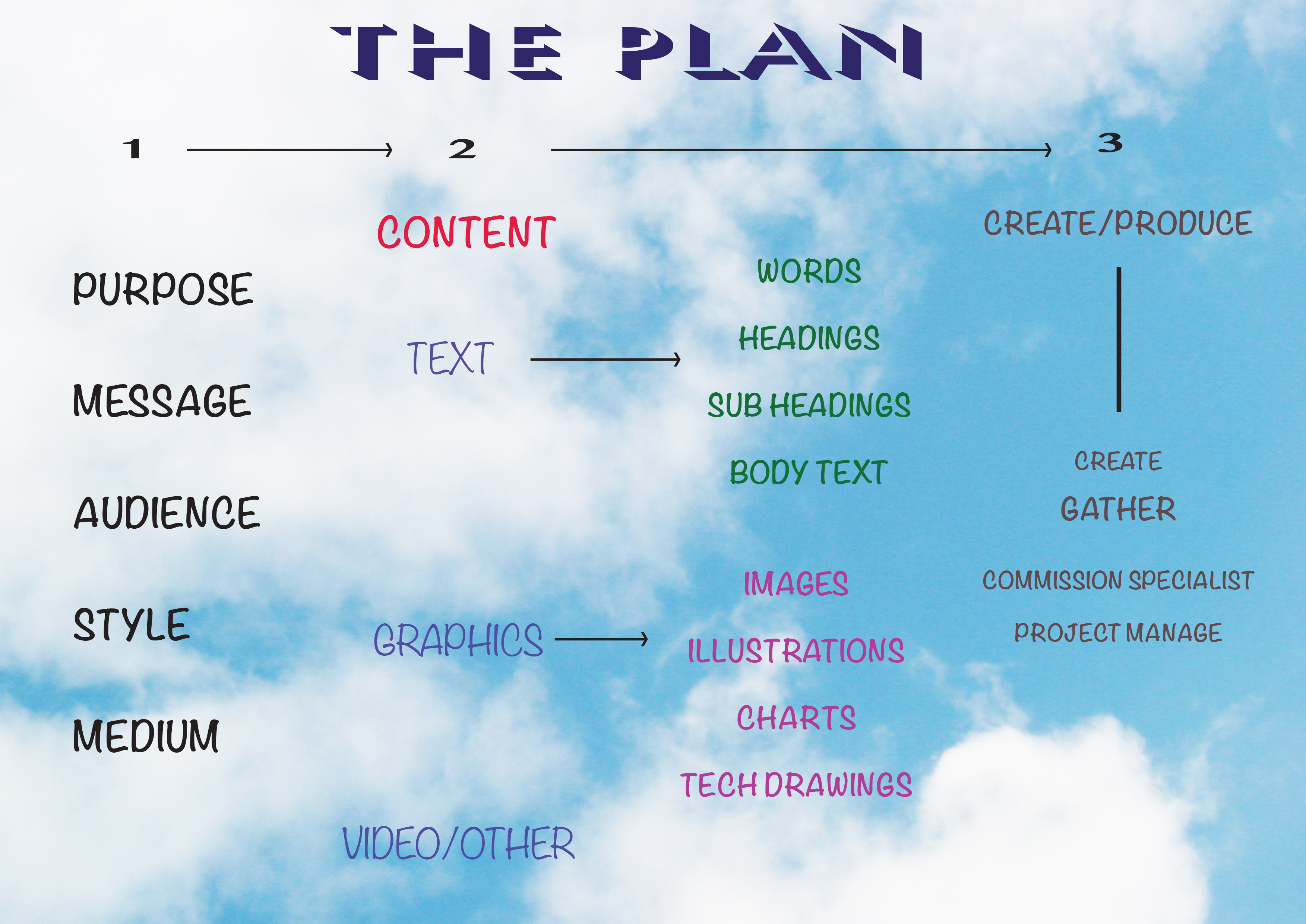
One thing became clear to me in the process. That is the importance of planning.

Having a series of plans that start with the Big Picture (see above,) is a good way to not only focus on what you are building, but also becoming ready to create and stay on track with projects.

Creativity is pure. We know that. Artists are born that way or are they? Real art is intuitive, it’s just there in moments of genius or is it?

Leonardo da Vinci and Michelangelo (both successful businessmen) produced ‘rough’ studies before creating their masterpieces.

My friend, famed Australian artist Rodney Pople, executes a number of sketches and daubs before he knows he’s on the track.

Writers plan and signpost using a variety of methods. Chapter headings is one way to write a novel.

Having a ‘helicopter view’ of what you are trying to achieve and then implementing it is a good way to plan and build.

It can be visual or text based. I find that visual is better.

Just get it all down and make your map.

I love it. Take it out! Part 2

22 Sep

Image

What was exciting about working in this environment was the chance to watch the words, art direction, talent and production all culminate in an ad campaign. I watched our agency put in a new government with a real US style campaign and I overheard the Chairman telling the future Prime Minister what he was doing wrong.

During this time I had the chance to pitch myself for a place in a highly thought of creative school. It was simply called The Copy School. I wrote a radio ad featuring myself as an ideas cowboy riding into town. I was good but I was green, ending with a Sam Elliott (Big Lebowski) narrator/Voice Over saying nice colour green. That got me over the edge and I was accepted with 10 others into this elite school. Each week we would attend an agency and be hands on trained by the top CD’s who would give us a practical assignment … an ad to write.

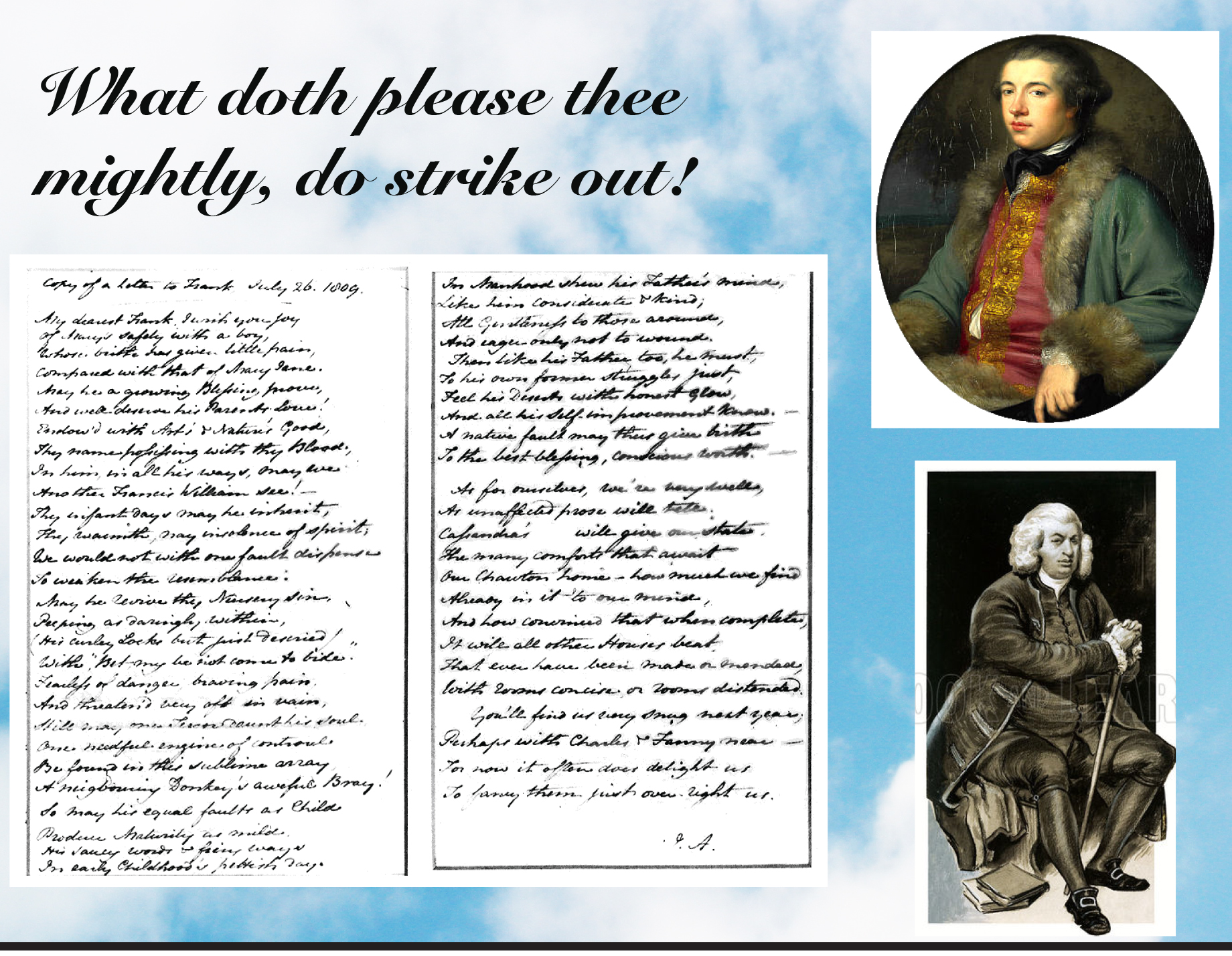
One of them, a man who went on to become a best selling author quoted Dr Samuel Johnson as saying ‘What doth please the mightly, do strike out.’ Dr Johnson or his biographer Boswell. I think he took some paraphrasing liberties there but I got the message.

What we love. What we think is sparkling copy. What we think is clever may not be right for the product or the audience. David Ogilvy was tight on the rules of writing.

It’s good to keep that in mind and not be married to our words.

It’s a lesson I never forgot.

Oscar Wilde famously quipped:

I worked very hard today. This morning I put in a comma and this afternoon I took it out.

I love it. Take it out! Part 1

21 Sep

ImageI got my first job in advertising by showing up at an agency with a two page short story I had written about bikies. I still remember one memorable phrase I concocted. It went something like ‘their jeans were so dirty, they could only be removed with a blow torch.’

The amazing thing was not only did I get in and meet with the Creative Director, but he gave me a job on the very lowest branch of the agency tree: the despatch department, run by a fiery red-faced ex army guy they called Sarge. I wanted to write. To create. I was on cloud 9 or maybe even 10.

For the first few days, the CD would acknowledge me. Smile. Ask how I was doing. That stopped soon after. But it was a great place to work. Big clients, global agency. A bunch of creatives around, artists, writers, producers, editors, designers. I loved it.

Then they promoted me to media accounts. Yike! That wasn’t my bag, so they put me into media planning, under a benevolent media genius who will remain nameless, but let’s call him Daniel Boyce. One day he called me into his office and asked me ‘so how are you liking it here?’ I was momentarily blinded by his striped shirt and the harbour view behind him, and blurted out without thinking ‘I don’t like it.’ Daniel fixed me with a steely glare, just as the phone rang. ‘Daniel Boyce.’ He said into the mouthpiece in a cultured accent, glancing at me with what I perceived as contempt. “I’m going to get fired.’ I thought, but no. Daniel put down the phone and asked me why I wasn’t happy in media planning. I told him that I wanted to write. To be a copywriter. To be a creative. The phone rang again. Same rigmarole. Then, ‘Thanks for being honest. Everybody lies to me around here.’

The next day I was relocated to the TV/Broadcast unit where ads were recorded and edited, pilots were made and new business pitches run.

We had two theatres and a big meeting room. I was able to watch actors, writers, engineers create, edit and senior executives pitch for new business. Something different everyday.

It may have been airlines and soft drinks but it was wondrous to me …

I said just follow the lesson plan

17 Sep

Smartboard1

I’ve been a trainer/teacher for quite some time. I’m also an instructional designer which is a fancy, schmancy way of saying I write training courses.

I work online (Learning Management Systems) and in the classroom. I find both interesting and sometimes exciting. Sometimes I leave a training session and I feel alive, electric.

And I must also say that I get great feedback on my training sessions. If I don’t beat my own drum who else is going to?

Now I respect lesson plans and facilitator guides > I write quite a few. But do I follow them? Sometimes yes and sometimes no.

Like everything in life it’s vital to get a message across. How? With humour. Surprise. Coming out of left field (that must be a baseball expression?)

Once I caught myself rambling on … one of the participants eyes blinked too many times. Someone up the back stifled a yawn.

‘Blah, blah, blah, blah.’ I said that out aloud. ‘Blah, blah, blah, blah. Is that what I’m beginning to sound like?’ I already knew the answer.

When your delivering training … keep them interested. In the palm of your hand. Like they don’t know what’s coming next.

But always bring it back to your objective … teaching people.