Archive | Communicating RSS feed for this section

Meet Dr NO

12 Dec

Image

When my son was a toddler my dear mother in law happened to mention that it was sad that little kids heard the word NO a lot of the time.

NO you can’t do that.

NO don’t be naughty.

NO. NO. NO.

Workplaces can be like that too.

Have you worked with a Dr NO? I know I have.

NO, too different.

NO, you can’t do that.

NO, NO, NO.

What makes a Dr NO?

Fear of change

Insecurity

Resentment

Risk aversion

All of the above. The only problem is that the world is changing. Industries are disappearing. Just this week our iconic car, the Holden, announced they were ceasing manufacturing here. Horror. All those people losing their jobs.

What will they do?

They’ll do something else.

Creativity is the enemy of Dr NO

Change is like Ju Jitsu … when you are attacked you step aside and push your attacker past. Going with the flow.

Scary but ultimately satisfying.

Hello SILO … you’d better be flexible!

3 Dec

ImageI work on many projects with many different organisations. Corporations, authorities, not for profits and small to medium businesses and I often find that I’m cast adrift between mountains of giant silos.

Silos form when the left hand doesn’t know what the right hand is doing.

I’m not casting aspersions (or aspidistras) at all the hard working people I interact with. I’m just making an observation. Silos form when people are rushing to meet change.

Change happens rapidly these days. Policies change, then procedures or ways of doing things. Regulations and laws change when governments change or government policy changes. Change happens when businesses are growing exponentially and new people are brought on board.

Silos also form when there’s a lack of communication across organisations, strategic business units (SBU’s) and teams.

Silos can also form when people don’t share.

Silos affect content developers too. We can be working away using some accepted template, or creating content in a suggested way and then … it’s not quite right.

Can this be a problem? Yes and no.

Clever consultants can pick a silo a milo off (sorry, it rhymed.)

Clever consultants communicate widely.

Clever consultants are flexible and don’t go into spasms of disappointment  and take things personally regarding their work.

My mum told me that a truly sane person has an ingrained ability to change their minds!

I tell my kid all the time, life is full of paradoxes … be flexible and open minded.

And smile a lot          : )

I just want to be a useful little engine

22 Nov

Image

I do love being a dad. It’s the most fun I’ve ever had. I especially used to love watching the kids shows with my son when he was a bit younger. He’s on his way to becoming a teenager so we’ll see … but he’s still my boy.

We used to watch a lot of shows together like Fireman Sam, Postman Pat and of course Thomas the Tank Engine. What I really enjoyed was the cosy atmosphere of the small villages where these shows are set. Some are in Wales and feature the beautiful lilting Welsh accent (it’s not a burr is it?) Tight knit communities where everyone seemed to be looking after each other. The characters are warm and friendly and … sweet.

Which brings me to Thomas and his oft heard catch cry “I just want to be a useful little engine!” Sometimes the Fat Controller gave Thomas a real job to do and off he’d go with his smile beaming.

There are lots of people in businesses and organisations everywhere that just want the same thing. They do their job and put something extra in and sometimes, even often, they are overlooked. Why? Because some other engines aren’t so humble. They roar around and make sure they’re seen.

I work with a Thomas. It’s a she actually. She’s a front line customer service/technical support for a medical business and she does a great job. You only have to hear her on the phone to notice the goodwill she spreads. Nothing is a problem and she not only sells, but advises and counsels. It’s all part of the job for this lady.

She’s a useful little engine!

Where would we be without them?

Take time to notice all the useful little engines at your workplace. Get them to train up or mentor other little engines. make it best practice and … reward them!

Love makes the business world go round.

Icons of Style and Style Guides

12 Nov

ImageCary Grant was a movie star when movie stars were stars if you get my drift. He’s probably not relevant to the Gen X. Y’s and Z’s (are they here yet?) but he had style, and talent did old Archie Leach … that was his real name. Cary Grant was a branded product for the Hollywood studio system and no-one did better business than those factories.

Stars like George Clooney owe a lot to Cary Grant an icon of style!

Now I’m not writing about movie stars here. I’m writing about the importance of Style Guides to content developers, whether they are building, writing, or video-ing content. Whether they are designing training programs or sending out email marketing campaigns > it’s nice to have guides in place for look and feel purposes, branding, version control, recurring text like copyright, fonts, colours and more.

Style guides should be global and accessible.

Style guides formats should be usable to those that need to use them.

Style guides should be simple, uncluttered and not a graphic designers view of how they should present and be used.

Most importantly, Style Guides should be communicated and adopted by all in the business or organisation.

I’m creative and I like to break the mould sometimes and add personality but I appreciate when Style Guides and Templates are used when it makes the project clearer and easier to format.

Develop Style Guides and Templates then manage projects. 

Percy Bysshe Shelley … Ode to a Control Freak

3 Nov

ImageI had an amusing english teacher at High School. He had a loud voice and a pompous manner. He liked to peer at the more rebellious among us and proclaim quite stentoriously ‘shut up son or I’ll belt you!’ And back then, he did and they could. Under this man’s iron fisted rule I learned about certain poets and poetry. The only poem that I can still recite is Ozymandius:

‘I met a traveller from an antique land
Who said: “Two vast and trunkless legs of stone
Stand in the desert…’

The poet was that great pioneer of pop star literati poet loser Percy Shelley. He also wrote Ode to a Grecian Urn amongst other treasures. But Ozymandius has always fascinated me. A monumental king of kings > all gone, boom! Just a pile of dust.

Which brings me back to the blog. Control freaks. I kind of love them.

Just recently I was involved at a workplace. The minute I arrived and set up, a person was there, next to me.

Not to be at all sexist here, but it was a lady. A women. You know, the other sex.

She fixed me with her glaring gaze and started to let me know how things were done ‘around here.’ I nodded and smiled and occasionally muttered a phrase of complete understanding like ‘yeah sure.’ But I could see that she (who could have easily been a he) was lost somewhere. Maybe she was in the desert looking at the gigantic monument and trying to make out the visage. All I know is that she was on her own planet and i was only docking for a while.

Now, I’m experienced. I’ve been around the block a few times.

To be honest, I could have been a waiter at the last supper.

I’m skilled and reliable and people relate to me. When I teach they might not learn everything, but they have a good time, which makes for good learning. I use humour a lot to bring people back into the room and off their Iphones. It works for me. I get great feedback. All you have to do is tell me where and when, the topic/subject, any materials and leave me to it.

But this person, lets call them Ozzie had to control me. Why?

Well I thought about it later. What drives a control freak? Insecurity? A need for power? Recognition? Panic? Fear?

All of the above.

Control freaks should read some Shelley and start with Ozymandius.

‘I met a traveller from an antique land who said …’

The art of the knowledgebase

26 Oct

ImageWebsites have evolved.

In the not too distant past, a business or organisation would have a ‘webmaster’ build a site. It had all the usual suspects: Home; About US; Contact Details; Products etc. You’ve seen hundreds of them. Maybe even thousands. Static sites with a flash animation graphic to spice things up. Looked good. Never or hardly ever updated except for new product offerings.

Nowadays, in the fast paced, quick clicking social media environment, more is required.

The big question is: why will customers visit your site? Better still, why will people who are not yet customers visit. We call them prospects from ‘gold prospectors.’ Digging for gold.

The gold you put on your site is what differentiates your business from your competition. Yes you’ve got great products. But sites need to offer value in a whole lot of other ways.

One way is to provide a knowledgebase.

Articles. White papers. Videos. Blogs. Put it out there.

But ask yourself the question. “Does this content do something for my clients, customers and all the prospects out there just waiting to find a solution to their problems?”

Well does it?

Frank Sinatra and content development. I did it my way

29 Sep

APPROVEDI love Frank Sinatra. His phrasing was amazing (sorry about that one!)

One of my favourites is his rendition of ‘My Way.’ Originally a french song and re-written by legend Paul Anka, it’s a testament to uniqueness, bravery. resilience and self belief. Ol’ Blue Eyes put in all the blows, hits and lingering disappointments. This song is about living and by the soaring end, this listener is in no doubt that Frank lived a life.

I’m a my way kind of person. Strong minded and creative. I often run on instinct fuelled by experience > what’s going to work and what’s not.

But here’s the thing: when you’re planning websites; developing content (products, knowledgebases, social platforms etc.,) always communicate with your stakeholders (internal and external) regularly, get approval and formal sign off. 

This is not always easy. You have to pitch it right and differently depending on your audience. The cost/benefit analysis.

Many great ad campaigns have been ruined by ‘the client.’ They just want the logo bigger. They often don’t share your enthusiasm for standing out in a crowded marketplace. But they are the client nevertheless, nervous or not.

Set up a ‘milestone’ approval system so that everyone’s on the same page. I do love cliches.

And stay brave!!

I love it. Take it out! Part 2

22 Sep

Image

What was exciting about working in this environment was the chance to watch the words, art direction, talent and production all culminate in an ad campaign. I watched our agency put in a new government with a real US style campaign and I overheard the Chairman telling the future Prime Minister what he was doing wrong.

During this time I had the chance to pitch myself for a place in a highly thought of creative school. It was simply called The Copy School. I wrote a radio ad featuring myself as an ideas cowboy riding into town. I was good but I was green, ending with a Sam Elliott (Big Lebowski) narrator/Voice Over saying nice colour green. That got me over the edge and I was accepted with 10 others into this elite school. Each week we would attend an agency and be hands on trained by the top CD’s who would give us a practical assignment … an ad to write.

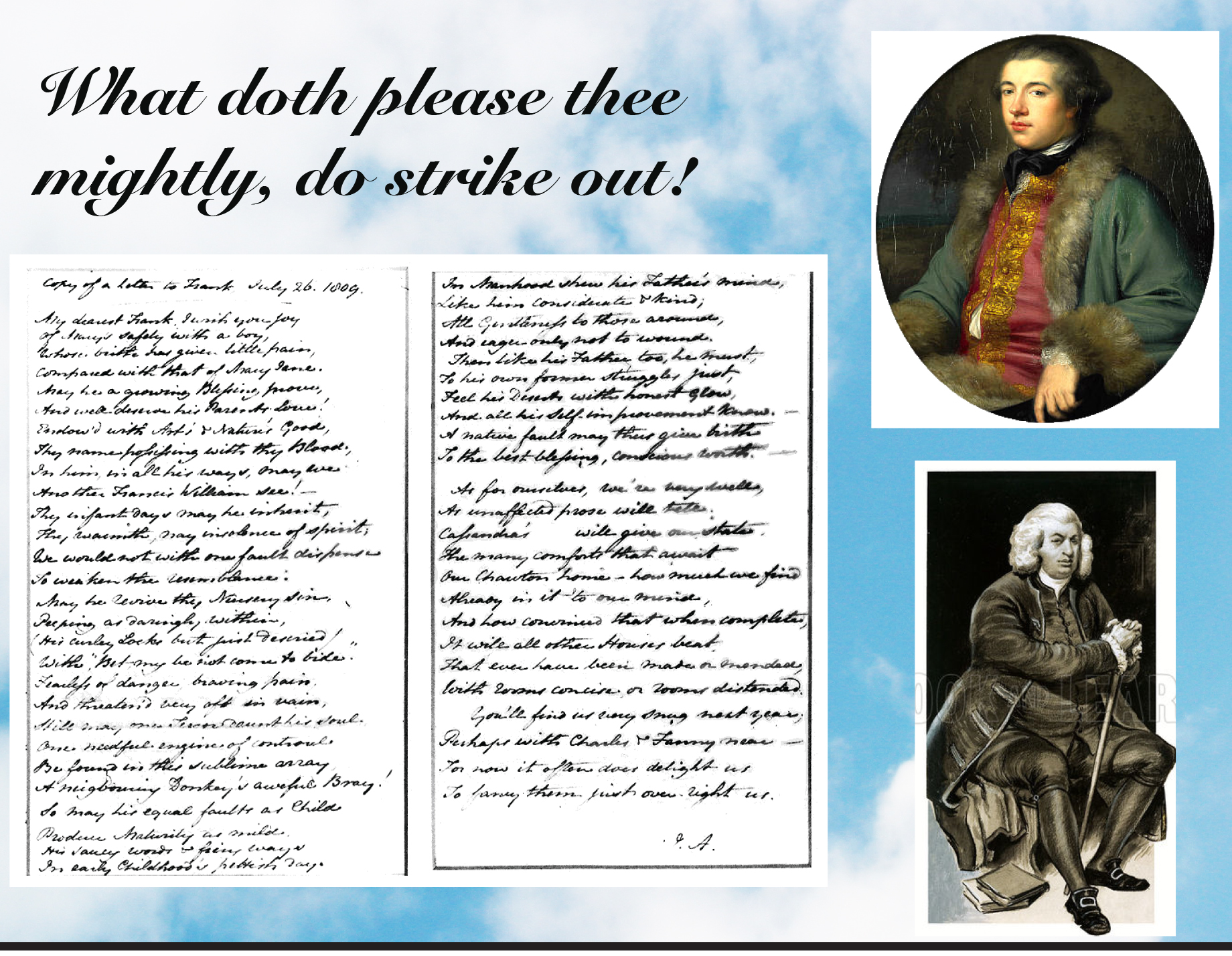
One of them, a man who went on to become a best selling author quoted Dr Samuel Johnson as saying ‘What doth please the mightly, do strike out.’ Dr Johnson or his biographer Boswell. I think he took some paraphrasing liberties there but I got the message.

What we love. What we think is sparkling copy. What we think is clever may not be right for the product or the audience. David Ogilvy was tight on the rules of writing.

It’s good to keep that in mind and not be married to our words.

It’s a lesson I never forgot.

Oscar Wilde famously quipped:

I worked very hard today. This morning I put in a comma and this afternoon I took it out.

I love it. Take it out! Part 1

21 Sep

ImageI got my first job in advertising by showing up at an agency with a two page short story I had written about bikies. I still remember one memorable phrase I concocted. It went something like ‘their jeans were so dirty, they could only be removed with a blow torch.’

The amazing thing was not only did I get in and meet with the Creative Director, but he gave me a job on the very lowest branch of the agency tree: the despatch department, run by a fiery red-faced ex army guy they called Sarge. I wanted to write. To create. I was on cloud 9 or maybe even 10.

For the first few days, the CD would acknowledge me. Smile. Ask how I was doing. That stopped soon after. But it was a great place to work. Big clients, global agency. A bunch of creatives around, artists, writers, producers, editors, designers. I loved it.

Then they promoted me to media accounts. Yike! That wasn’t my bag, so they put me into media planning, under a benevolent media genius who will remain nameless, but let’s call him Daniel Boyce. One day he called me into his office and asked me ‘so how are you liking it here?’ I was momentarily blinded by his striped shirt and the harbour view behind him, and blurted out without thinking ‘I don’t like it.’ Daniel fixed me with a steely glare, just as the phone rang. ‘Daniel Boyce.’ He said into the mouthpiece in a cultured accent, glancing at me with what I perceived as contempt. “I’m going to get fired.’ I thought, but no. Daniel put down the phone and asked me why I wasn’t happy in media planning. I told him that I wanted to write. To be a copywriter. To be a creative. The phone rang again. Same rigmarole. Then, ‘Thanks for being honest. Everybody lies to me around here.’

The next day I was relocated to the TV/Broadcast unit where ads were recorded and edited, pilots were made and new business pitches run.

We had two theatres and a big meeting room. I was able to watch actors, writers, engineers create, edit and senior executives pitch for new business. Something different everyday.

It may have been airlines and soft drinks but it was wondrous to me …

I said just follow the lesson plan

17 Sep

Smartboard1

I’ve been a trainer/teacher for quite some time. I’m also an instructional designer which is a fancy, schmancy way of saying I write training courses.

I work online (Learning Management Systems) and in the classroom. I find both interesting and sometimes exciting. Sometimes I leave a training session and I feel alive, electric.

And I must also say that I get great feedback on my training sessions. If I don’t beat my own drum who else is going to?

Now I respect lesson plans and facilitator guides > I write quite a few. But do I follow them? Sometimes yes and sometimes no.

Like everything in life it’s vital to get a message across. How? With humour. Surprise. Coming out of left field (that must be a baseball expression?)

Once I caught myself rambling on … one of the participants eyes blinked too many times. Someone up the back stifled a yawn.

‘Blah, blah, blah, blah.’ I said that out aloud. ‘Blah, blah, blah, blah. Is that what I’m beginning to sound like?’ I already knew the answer.

When your delivering training … keep them interested. In the palm of your hand. Like they don’t know what’s coming next.

But always bring it back to your objective … teaching people.